
This case study is anonymised. The data is drawn from a Recovery Analysis conducted for an actual EU fashion value retailer, using the retailer’s own inventory, returns, and disposal data. All financial figures reflect identified potential based on verified transaction and operational records.
The Situation
A large EU-domiciled fashion value retailer processing significant volumes of returned and end-of-season inventory annually. Returns are graded through a basic good/bad classification with limited condition differentiation. Disposal decisions are made at batch level with no item-level tracking. The retailer has no documented methodology for assessing whether destruction is cost-effective and no structured evidence trail for disposal decisions.
With ESPR Article 25 enforcement approaching in July 2026, the retailer faces an immediate compliance gap: the existing returns process generates neither the derogation documentation Article 3 requires nor the disclosure data Article 24 mandates.
The Approach
The Invalusys Recovery Analysis was applied to the retailer’s returns data. The existing good/bad grading was assessed against the five-grade A–E taxonomy, with each grade mapped to a defined compliance pathway. The analysis modelled what item-level tracking would deliver: linking each unit to a grade assignment, pathway routing, and projected outcome.
The DER-NCE calculation was applied at Grade C and D level, using reconditioning cost benchmarks and resale recovery data to determine the cost-effectiveness threshold for each category. This identified which items are genuinely uneconomic to repair — eligible for derogation — and which are currently being destroyed despite having positive net recovery potential.
What the Recovery Analysis Identified
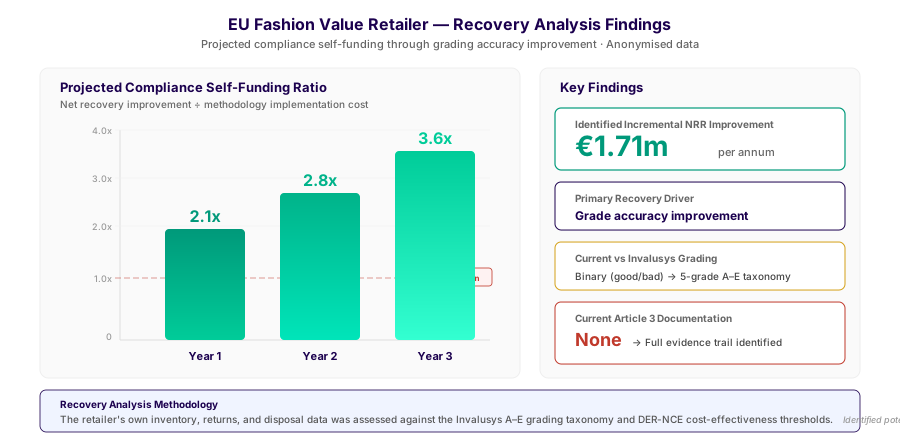
€1.71 million incremental net recovery improvement identified
Grade accuracy improvements would redirect inventory from destruction and bulk disposal into higher-value resale and reconditioning channels. Items currently classified as waste under the binary grading system were identified as Grade B or C — commercially recoverable through the right channel at the right price.
Compliance self-funding at 2.1x coverage in Year 1
The projected net recovery improvement exceeds the total cost of implementing the Invalusys methodology by a factor of 2.1 in Year 1, rising to 3.6x by Year 3 as grading accuracy improves and channel optimisation matures. The analysis demonstrates that compliance is not a cost centre — it is a commercially positive investment from the first year.
Item-level evidence trail for Article 3 compliance
The analysis mapped the retailer’s current documentation position against Article 3 requirements. Under the Invalusys methodology, every destruction decision would be documented with the evidence Article 3 requires: quality assessment procedures, grade assignments, cost-effectiveness calculations, and derogation classification. The retailer would move from zero audit documentation to a fully defensible evidence base.
LOI compliance clauses become enforceable
The retailer has Letters of Intent with disposal partners containing compliance clauses. Without item-level tracking, these clauses are aspirational — the retailer cannot verify whether partners are meeting them. The Recovery Analysis identified that implementing the Invalusys grading and tracking framework would make LOI clauses operationally enforceable for the first time.
What This Demonstrates
The Recovery Analysis illustrates three principles that apply across the fashion sector:
Grading accuracy determines both compliance and commercial outcomes
The same assessment that generates regulatory evidence also identifies recovery opportunities. These are not separate workstreams — they are the same operational process with different outputs.
Compliance can be commercially self-funding when the methodology is correct
The projected cost of implementing a defensible derogation methodology is recovered through improved grade accuracy and channel optimisation. Brands that treat compliance as a pure cost burden are underestimating the commercial value of the data the process generates.
Item-level tracking transforms governance from aspiration to enforcement
Compliance clauses, audit commitments, and disposal partner obligations are only as strong as the operational infrastructure that verifies them. Batch-level processing generates compliance risk. Item-level tracking resolves it.